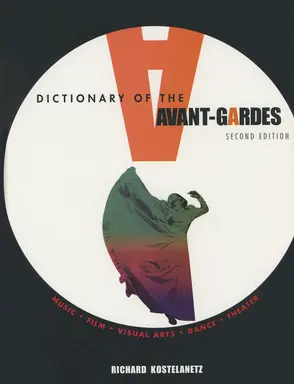
The encyclopedia by Richard Kostelanetz, an independent writer, filmmaker, and performing artist, brings together a wealth of information on aesthetic innovation in the arts, including music, film, literature, the visual arts, dance, and theater. The artists included were mainly active in the 20th century, with no birth date earlier than Edward Lear's (1812–88). They include such well-known subjects as Charles Ives, John Lennon, Igor Stravinsky, Edgard Varèse, and contemporary figures as environmental-artist Christo and performance-artist Laurie Anderson. The entries for Kinetic Art, Serial Musk, Mixed-Means Theater, Zaum (poetry), SoHo, and Something Else Press create a rich image of a period. The second edition is enlarged and revised, with an added photo insert. It makes the avant-garde art easily accessible to au courant researchers and fills a gap in reference collections.
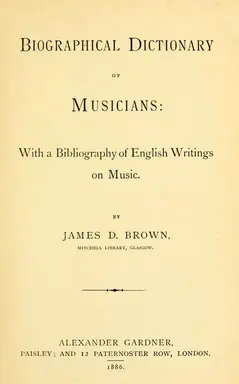
Biographical dictionary of musicians, with a bibliography of English writings on music
This single-volume dictionary was compiled by the English librarian James Duff Brown (1862–1914), an early advocate of public music libraries. It features short entries devoted to performers, composers and their works, and instrument makers, and it gives special prominence to British musicians, including many minor figures. As Brown notes in the Preface, he has included only those foreign musicians who either “claim attention by their acknowledged eminence” or have a direct connection with Britain. The entries on many living musicians were revised and corrected by the musicians themselves, with whom Brown corresponded. The volume includes a bibliography of British writings on music, organized by subject. With its emphasis on British musicians and the bibliography of British writings, this dictionary is particularly useful for scholars of 19th-century British musical life.
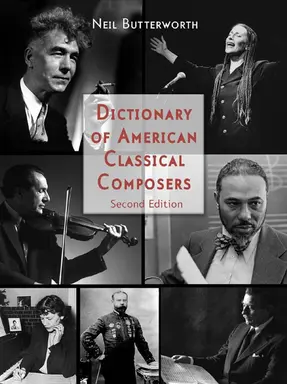
Twenty years after Garland published A dictionary of American composers (1984) this second edition offers a fresh look at 650 composers from the 18th century to the present, with new, expanded, and updated entries. It gives a wealth of information on American-born or naturalized composers and their significant works. Composers of light music, jazz, and popular songs are omitted, with the exception of the historically significant Stephen Foster. An expanded appendix of composers, listed by teacher, is included. Though the entries are similar in scope to those in Grove’s music dictionaries, Butterworth (formerly of Napier University, Scotland) has included many entries that do not appear there or in other common reference works. The volume is thus unique.
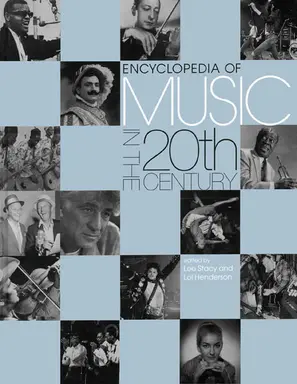
This concise, one-volume encyclopedia covers all aspects of 20th-century music from around the world, ranging from classical to popular genres, with entries devoted to composers, performers, genres and styles of music, countries, and regions. In addition to providing biographical and historical context, many articles contain suggestions for further reading and listening and cross-references to other relevant entries. The encyclopedia also features a biographical digest, with sentence-long descriptions of performers and composers, a glossary, a comprehensive bibliography, and an index. With its easy-to-read prose and user-friendly layout, this encyclopedia is particularly well-suited for entry-level students and a general audience seeking basic knowledge about 20th-century music.
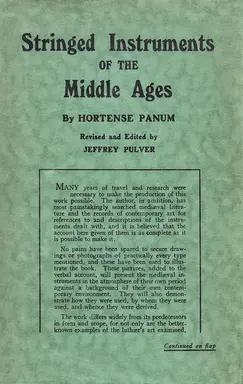
The stringed instruments of the Middle Ages: Their evolution and development
The Danish musicologist Hortense Panum (1856–1933) published Middelalderens strengeinstrumenter og deres forløbere i oldtiden in three volumes over a period of 16 years (1915, 1928, 1931). The long publication process allowed Panum to consider newly published literature on the subject, which gave her an opportunity to enter into dialogue with colleagues who held different opinions, among them Curt Sachs and Francis Galpin. Indeed, Panum refused to accept the widely held assumption that instruments had arisen independently in two distinct times and places, and in a Darwinian approach she decided to find the missing links between the two seemingly unrelated parts of string instruments’ history. As few instruments or fragments of instruments had been preserved, her research relied on iconographic and literary sources. Panum’s opus contains an impressive number of over 400 images that depict stringed instruments of antiquity and the Middle Ages, many of them less familiar to the music researcher. The section on specific Nordic instruments is a particularly pioneering work. Jeffrey Pulver (1884–1984), author of the valuable Biographical dictionary of Old English music (1927), recognizing Middelalderens strengeinstrumenter as a standard reference work, created the one-volume English translation.