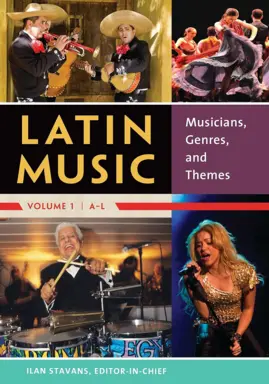
Latin music: Musicians, genres, and themes provides an in-depth exploration of the rich and diverse world of Latin music, examining its history, cultural significance, and the wide range of genres it encompasses. The encyclopedia covers the evolution of Latin music from its roots in Indigenous, African, and European traditions to its contemporary global influence. It offers detailed profiles of influential musicians, including iconic figures such as Tito Puente, Celia Cruz, and Carlos Santana, shedding light on their contributions to the development of Latin music and their lasting legacies. The two volumes delve into key genres like salsa, merengue, bachata, tango, and reggaetón, discussing their origins, stylistic characteristics, and cultural impact across different Latin American countries and communities. In addition to genre exploration, Latin music touches on broader themes such as identity, migration, and the ways in which Latin music has become a vehicle for social and political expression. The 244 entries also include socio-political factors that have shaped Latin music’s growth and dissemination. This is a key resource for music researchers looking to understand the musical traditions, key figures, and cultural contexts that have defined Latin music and its enduring global appeal.
Music theory from Zarlino to Schenker is a comprehensive resource that provides insight into the history of music theory through 233 entries that profile the field’s proponents, from Joseph Adlung to Johann Joseph Fux, from Jean-Philippe Rameau to Bernhard Ziehn. Each entry provides critical insights into the figures’ contributions to music theory, drawing on their respective expertise in harmony, counterpoint, or form, or form. Each entry contains a curated bibliography. Title and chronological indices serve as a valuable reference for scholars, offering an overview of theoretical writings and the milestones of the field over several centuries, from the Renaissance through the early 20th century. By organizing the vast array of materials chronologically and thematically, Music theory helps the researcher understand theoretical thought across different eras. The tome emphasizes the contribution of individuals to music theory and the transformation of concepts, showing how earlier and ideas are interconnected.
This biographical dictionary chronicles all the master craftsmen involved in instrument making in New York City, from the obscure work of Geoffry Stafford in 1691 to the zenith of the 1890s, and on to the Great Depression of the 1930s. Many of the 1095 detailed entries focus on nineteenth-century makers, when the city was the largest producer of instruments in the Western Hemisphere, and designs and innovations pioneered by New York artisans influenced and inspired instrument makers throughout the world. Aside from providing a record of these instrument makers, the dictionary offers a historical study of an urban trade that is ultimately tied to the growth and development of the city.