
Publications
Filtres :Musical instruments: A comprehensive dictionary⊗Tout effacer
1 publications sur 1, page 1
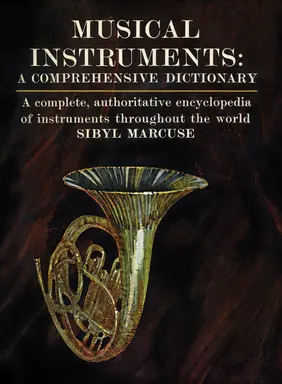
Musical instruments: A comprehensive dictionary
Sibyl Marcuse’s dictionary incorporates most of Sachs's material published in the Real-Lexikon, revises and expands it where necessary, and adds a vast number of new entries with copious cross-references leading the reader to additional information. Indeed, Marcuse offers thousands of entries on instruments from prehistoric times to the electronic instruments of today, and from all over the world. Entries include definitions and descriptions of instruments used in the Orient, Africa, the Americas, Polynesia, and beyond, as well as a broad treatment of instruments of the Western world. Marcuse has gone out of her way to offer information on instruments from remote places: the ha, a musical bow of the African bushman; the lumbambam, a small cylindrical drum, and the ndingi, a wooden cowbell, both of the Congo; the wurumbumba, a musical bow of the Congo and Angola; the abeng, a cane pipe of the Gabon Republic played through one nostril; the yurupuri, a wooden trumpet played in pairs by youths of the Amazon valley, and the xaque-xaque, one of a number of different Brazilian rattles; the bum-bum, a musical bow of Honduras; the ehecacozcatl, a shell trumpet of the pre-Columbian Toltec culture; the yan-ljin, the Tibetan cousin to a dulcimer; the wani-guchi, a ritual gong hung at the entrance to Japanese shrines and struck by worshippers; the zuffolo, a whistle flute of Lombardy; the zurrumbera, a bull-roarer of northern Spain; the German wurstfagott, a "sausage bassoon"; the abilosen adar, a Basque horn sounded at night to frighten away wild animals; and the eunuch flute found in Europe and resembling the kazoo (which is also called the bazoo). Marcuse’s comprehensive approach includes eclectic noisemakers, from signaling devices and bull-roarers to walkingstick violins, raft zithers, humming tops, and pibgorns. All entries are cross-referenced, etymologies are offered, and the foreign-language equivalents of the English terms are entered alphabetically in their own right. The plates of the 1964 edition show various instruments, well reproduced. In its comprehensiveness, the dictionary is indispensable for musicians, musicologists, ethnomusicologists, and curators. Anthropologists, archaeologists, sociologists, and other researchers will find much useful information as well.
Parcourir