Filtres :France⊗histoire générale de la musique⊗Tout effacer
5 publications sur 5, page 1
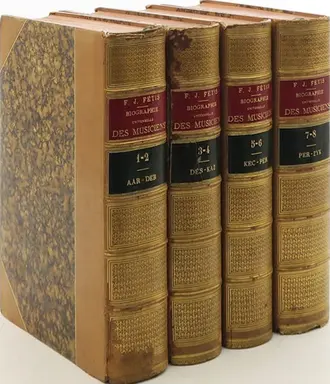
Biographie universelle des musiciens et bibliographie générale de la musique
The influential music critic and music educator François-Joseph Fétis (1784–1871) published the first edition of his Biographie universelle between 1835 and 1844. The dictionary is one of the most impressive single-author music reference works of the 19th century. The original eight volumes provide detailed biographical entries on Western European musicians. The second edition is expanded by a two-volume bibliographical supplement, compiled by Arthur Pougin between 1878 and 1880. The Biographie universelle is testament to Fétis’s personality: he had notoriously strong opinions and was unafraid to express them. Fétis was in an unparalleled position to write a comprehensive biography of musicians. In 1827, he founded the Revue musicale, one of the earliest and most influential specialist music journals of the 19th century, and from 1833 until his death he served as the Director of the Brussels Conservatory. Fétis had a large network of musical colleagues across Europe, and corresponded personally with many of the subjects featured in the Biographie universelle. The Biographie universelle provides an essential window into 19th-century French and European musical life, as distilled through the viewpoint of one writer at the center of that culture.
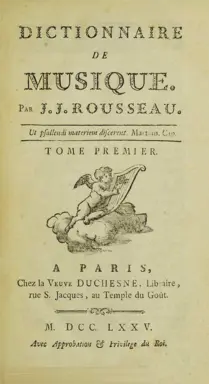
First printed around 1767/68, Rousseau’s Dictionnaire de musique is one of the early music reference works. It has been considered radical and traditional at the same time; radical, because Rousseau advanced in it an idiosyncratic philosophy on opera and revealed his rejection of French music tradition; traditional in that he held on to existing categories—music as art and music as science—and to views on music theory accepted in the 18th century. As a historiographer Rousseau is far from outdated. His entry for “monologue” marks the first appearance of the term in French musical lexicography. It synthesizes principles drawn from poetics and dramaturgy with stylistic arguments developed during the Querelle des Bouffons. Rousseau also makes the first effort to overcome Eurocentrism in music lexicography. Rousseau's volume is a rich source of information on contemporary reception of Bach, Händel, Haydn, and Mozart. The RILM Music Encyclopedias features the 1775 printing.
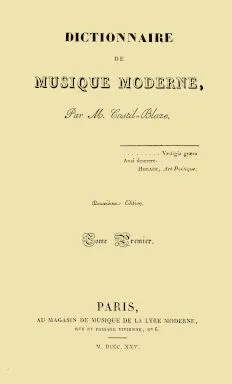
First published in 1821, by its title alone, Castil-Blaze’s dictionary appears as a modernized version of Jean-Jacques Rousseau’s Dictionnaire de musique. Conceptually in line with the practice of musical lexicography opened by the philosopher of Geneva, in the Dictionnaire de musique moderne Castil-Blaze significantly reshapes the approach. While following Rousseau, the French musicologist, music critic, composer, and music editor came to propose his own definitions. Accordingly the Dictionnaire de musique moderne is characterized by two overarching trends: Castil-Blaze follows Rousseau in terms of entry structure and content (save for some 80 entries which he literally copies), but he updates and makes accessible the entries to a broader readership by focusing on issues that relate to the contemporaneous state of music and doing so with great clarity. This is recognized by a contemporary who has made lexicographic music history himself, François-Joseph Fétis, who asserted: “Containing nothing that is not known to educated musicians, the Dictionnaire de musique moderne contains developments that are a little too considerable for others: with this slight defect… the book of M. Castil-Blaze deserves praise for the clarity of the definitions and the rectitude of judgement which are distinguished in most of the artists”. The second edition, of 1825, contains corrections, such as in the entries on counterpoint and figure. A third, abridged, version exists, printed in 1828 in Brussels and edited by Joseph Henri Mees, who outfitted it with a catalogue of theorists, composers, and deceased musicians active in the Low Countries and a short instructional text on music pedagogy.
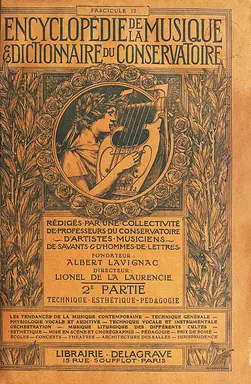
Encyclopédie de la musique et dictionnaire du Conservatoire
The French musicologist Albert Lavignac (1846–1916) conceived the Encyclopédie de la musique et dictionnaire du Conservatoire as a monumental encyclopedic undertaking with monograph-length studies by reputable French scholars. After Lavignac’s death, Lionel de La Laurencie (1861–1931) continued the project, but with his passing in 1933 the Encyclopédie was abandoned. The work as its stands consists of two parts. The first (comprising five volumes, first published between 1913 and 1922) concerns the history of music, with specific sections on periods (antiquity to Middle Ages) and on selected countries in Africa, Asia, Europe, and the Americas. The number of entries allocated to non-European music is especially noteworthy. Joanny Grosset’s major article on India may be counted the beginning of modern interest in Indian music in the French-speaking world. Similarly notable is Maurice Courant’s Essai sur la musique classique des Chinois. The second part (comprising six volumes, published between 1925 and 1931) focuses on aesthetics and theory, instruments and performance, religious music and venues. La Laurencie’s expertise in French music from Lully to Gluck led to well-balanced contributions in that subject area. The Encyclopédie is a work of universal musicology written from the French perspective after the fin-de-siècle. It has enjoyed considerable reputation among historical musicologists and ethnomusicologist alike [see Robert Lachmann’s review in Music & letters 4, no. 3 (1923): 290–291] and is indispensable for historiographic research.
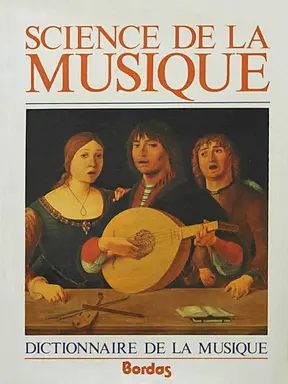
Science de la musique: Formes, technique, instruments
This two-volume encyclopedia, devoted to musical terms, complements Honegger’s Dictionnaire de la musique: Les hommes et leurs oeuvres. The result of collaboration among 170 French, European, and American musicologists, Science de la musique contains articles on such diverse topics as music theory, aesthetics, form, technique, musical instruments, music history, and countries and cities. Most articles feature extensive bibliographies.
Pays: France
Langue: français
Sujet: instruments, histoire générale de la musique