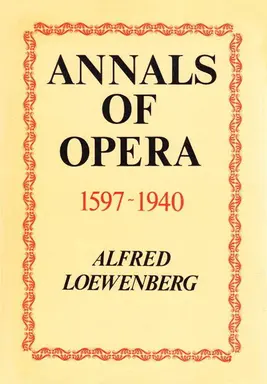
With Annals of Opera (1st ed., 1943; 2nd ed., 1955) the German-born British musicologist Alfred Lœwenberg (1902–49) created a monumental work that contains information on 4,000 operatic works. It details premieres and international performances of operas from Monteverdi's day to 1940. In the print edition, individual entries are organized by country, subdivided by composer and opera, and specify title, details of the premiere, librettist and source of libretto, cast list, conductor, director, and other key aspects related to production and performance history. The author himself was aware of the daunting task, introducing it as “a skeleton history of opera, in dates and fact” (Preface). But it is more than that, as it provides all basic facts on opera. The third edition is in essence a reprint of the previous ones, with revisions and updates by Harold Rosenthal (Loewenberg died before the completion of the second edition). Edward J. Dent, who wrote the preface to the third edition, states that “Some alterations and fairly numerous corrections have been made, and many new dates and other facts added from the author’s notes. Further corrections from other sources have been accepted and incorporated, but essentially the Annals remain Loewenberg’s work, presented here as far as possible in his own revision. No attempt has been made to carry the records beyond 1940”. Operas that have been recently revived or performed in newer versions are marked with an asterisk. Although the volume contains only a fraction of the operas performed between 1597 and 1940, it is still the most comprehensive listing for this time period: an exhaustive work, indispensable as reference book. Similar in format, but including some 60,000 titles, is Franz Stieger’s Opernlexikon.
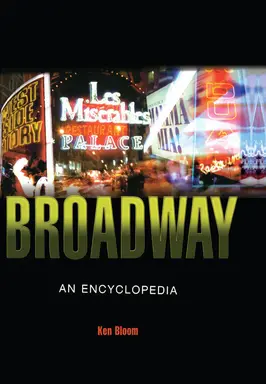
Broadway: Its history, people, and places—An encyclopedia
Theater historian Ken Bloom’s 1991 first edition of Broadway offered a fact-filled compendium of Broadway's theaters, personalities, awards, publications, and notable concepts (e.g., “stunts”), from the earliest days to the present. This new edition adds corrections and updates, and multiple cross references for easy browsing. The most substantial entries cover theaters, playwrights, composers, directors, performers, and producers; there is a special emphasis on composers and lyricists, because Bloom believes that “they had greater impact on American theatrical history” (Preface). This is not a show-by-show account (only a small number of major shows have solo entries), but a history of the Great White Way.
Pays: États-Unis
Langue: anglais
Sujet: musique populaire, interprètes, opéra et théâtre musical
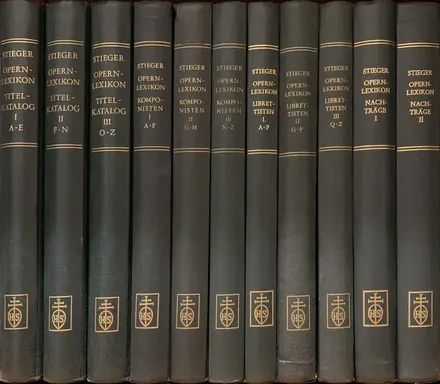
Opernlexikon/Opera catalogue/Lexique des opéras/Dizionario operistico
Franz Stieger’s Opernlexikon is one of the most frequently consulted of all opera catalogues. It also contains ballets, oratorios, and other stage works, all listed by title, composer, and librettist. Lists of serious operas, cross-indexing of titles, and identification of librettists are especially noteworthy. The concluding two volumes, titled Nachträge, contain corrections as well as additions. With over 60,000 titles of stage works, the Opernlexikon exceeds every other published opera catalogue in size. It provides the place and date of every work's premiere (when known), along with an identification of its genre and number of acts. The Opernlexikon is especially valuable for works written and performed before 1920. A short introduction by Franz Grasberger, librarian of the music division of the Österreichische Nationalbibliothek, highlights the catalogue’s value in light of previously unpublished information. Grasberger also provides biographical information, not available elsewhere, on Stieger (1843–1938).
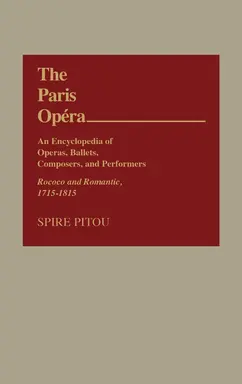
The Paris Opéra: An encyclopedia of operas, ballets, composers, and performers
Spire Pitou, who served as Professor of French Language and Literature at the University of Delaware, produced in this book an exhaustively detailed encyclopedia of every opera and ballet produced at the Paris Opéra, or the later Opéra-Comique, from 1671 to the 1980s. It is of special value to those who requiring in-depth information on opera in France. Entries for operas and ballets include composer, librettist, choreographer, costumer, set designer, important performers, and a scene-by-scene/act-by-act analysis. Separate entries are also devoted to performers, composers, choreographers, librettists, genres, and scenographers. Each of the three volumes begins with a concise historical overview for its assigned time period, which is informative and helpful for anyone requiring orientation on French operatic tradition.
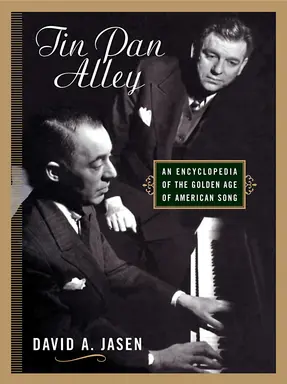
Tin Pan Alley: An encyclopedia of the golden age of American song
In Tin Pan Alley, David Jasen, a Professor of Communications at C.W. Post College (Long Island University) and an authority on ragtime, tells the story of American popular song, as it was composed, published, and marketed from its heyday in the 1880s to Tin Pan Alley’s demise in the 1950s. It does this through over 400 individual entries, each featuring a composer, lyricist, performer, publisher, style, or song title. One entry of particular interest is headed Hit Songs. Twenty pages cover the years from the 1890s to 1955; for each year, four or five successes are described with recording details and annotated entries for the era's blockbusters. Since Tin Pan Alley was essentially a publishing movement, Jasen includes publisher entries, often with dates and addresses. Tin Pan Alley is a unique compendium on American popular song and the business of selling music.
Pays: États-Unis
Langue: anglais
Sujet: musique populaire, opéra et théâtre musical