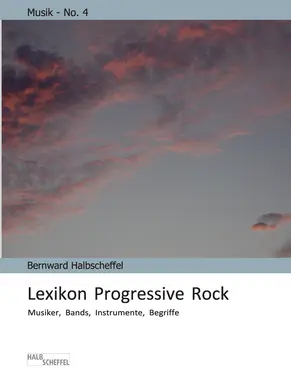
The Lexikon Progressive Rock provides more than 500 articles that feature not only classics of prog rock such as Procol Harum, The Nice, Yes, Emerson, Lake & Palmer, Genesis, and King Crimson, but also more recent groups like Dream Theater, Gazpacho, Glass Hammer, Porcupine Tree, Shining, Spock’s Beard, and Grand General. Representatives of progressive metal are also included, among them Opeth, Symphony X, and Epica. Although British and American prog mainstream is dominant, the lexicon also offers articles on obscure bands like Ozric Tentacles and The Legendary Pink Dots; progenitors of art rock like Roxy Music and 10cc; and the Canterbury scene with Delivery, Soft Machine, Henry Cow, and Caravan. Halbscheffel addresses currents of retroprog, neoprog, and new artrock. The 2013 edition replaces some earlier articles on foundational musical terms with new articles that are specifically relevant for progressive rock, such as the entry on polyrhythmics. New articles focus on current bands like Nosound, Knight Area, and Flying Colors. Halbscheffel aptly summarizes this all-encompassing approach in the article "Progressive Rock", where he focuses on the history of the genre less as a stylistic history than as a history of a functionally oriented inventory of rock techniques and processes.
Music theory from Zarlino to Schenker is a comprehensive resource that provides insight into the history of music theory through 233 entries that profile the field’s proponents, from Joseph Adlung to Johann Joseph Fux, from Jean-Philippe Rameau to Bernhard Ziehn. Each entry provides critical insights into the figures’ contributions to music theory, drawing on their respective expertise in harmony, counterpoint, or form, or form. Each entry contains a curated bibliography. Title and chronological indices serve as a valuable reference for scholars, offering an overview of theoretical writings and the milestones of the field over several centuries, from the Renaissance through the early 20th century. By organizing the vast array of materials chronologically and thematically, Music theory helps the researcher understand theoretical thought across different eras. The tome emphasizes the contribution of individuals to music theory and the transformation of concepts, showing how earlier and ideas are interconnected.
This biographical dictionary chronicles all the master craftsmen involved in instrument making in New York City, from the obscure work of Geoffry Stafford in 1691 to the zenith of the 1890s, and on to the Great Depression of the 1930s. Many of the 1095 detailed entries focus on nineteenth-century makers, when the city was the largest producer of instruments in the Western Hemisphere, and designs and innovations pioneered by New York artisans influenced and inspired instrument makers throughout the world. Aside from providing a record of these instrument makers, the dictionary offers a historical study of an urban trade that is ultimately tied to the growth and development of the city.
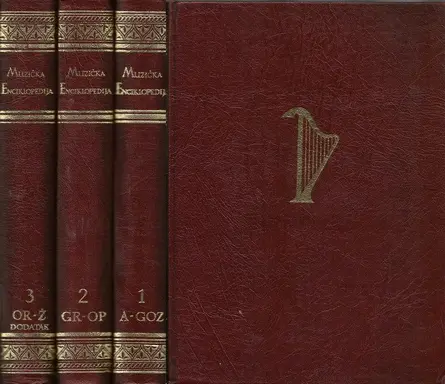
The Muzička enciklopedija was first published in two volumes in 1958/1963 under the editorship by the eminent Croatian music historian Josip Andreis (1909–1982), followed by a second edition in three volumes which appeared from 1971 to 1977. Numerous biographical articles describe the life and output of composers along with exhaustive works lists; as well as the activities of many conductors, singers, instrumental virtuosos, music theorists, and critics. In subject articles, historical and contemporary musical instruments are described in detail, as well as all musical genres and forms, such as arias, canzones, cantatas, operas, symphonies, sonatas, and overtures. Many important domestic and foreign music societies, instrumental and dance ensembles, and music festivals and institutions are presented. The second edition features new articles on contemporary, avant-garde, and experimental music and musical personalities, from aleatoricism and dodecaphony to electronic and serial music. This edition also includes articles about artists from the world of pop music as well as jazz. Considering that choreographers and dancers often intersect with music on stage, the editorial board introduced a number of names from this creative field. For the sake of better integration, the folk music of each nation is included in geographical entries, joining the section on art music. The second edition features ample illustrations, increasing the number of artistic contributions in etching and color, selected by Koraljka Kos.