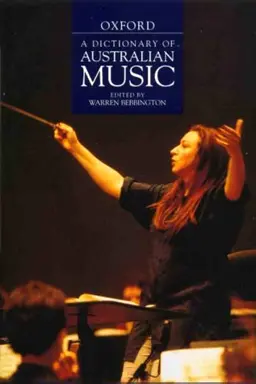
This is the first comprehensive reference work on Australian music. With just over 1400 entries written by 125 authorities on the subject, the dictionary covers a wide spectrum of topics, from ancient Aboriginal traditions and European-derived orchestral, operatic, and concert music, to Australian folk, jazz, country, popular, rock, electronic, and experimental music. There are entries on major historical and contemporary figures, including those who have achieved worldwide fame, such as Peter Allen, Percy Grainger, Peggy Glanville-Hicks, Kylie Minogue, Barry Tuckwell, Charles Mackerras, and the three great divas: Nellie Melba, Joan Hammond, and Joan Sutherland. Leading orchestras and ensembles are represented, as well as major pop and rock groups, among them the Seekers, the Bee Gees, AC/DC, and Midnight Oil. In addition to entries on individual composers, performers, and musical works and instruments, the dictionary covers leading musicologists, critics, broadcasters, educators, and researchers. The dictionary thus considers and reflects the diversity of music on the Australian continent.
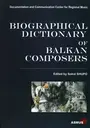
Biographical dictionary of Balkan composers offers a comprehensive look at the lives and works of 500 composers from countries such as Albania, Bulgaria, Greece, Romania, Serbia, Croatia, and others and from various periods, from the 19th century to the turn of the century. The entries—conceived by a team of authors, translators, and editors—offer insights into the composers’ musical achievements, providing information on key compositions and their contributions to the development of music in the Balkans, documenting their education, stylistic evolution, and major works. The dictionary highlights how Balkan composers have drawn from a unique blend of local traditions, Byzantine liturgical music, and Western classical forms to create a distinctive regional repertoire. It also explores the socio-political context in which these composers worked, as well as how national identity and political changes in the Balkans influenced their music. This dictionary is complementary to the Enciklopedia e muzikës shqiptare, Leksikon jugoslavenske muzike, and Muzička enciklopedija, which together make RILM Music Encyclopedias an invaluable resource for anyone interested in the cultural and musical history of the Balkans, illuminating the richness and diversity of this often underrepresented region in music scholarship.
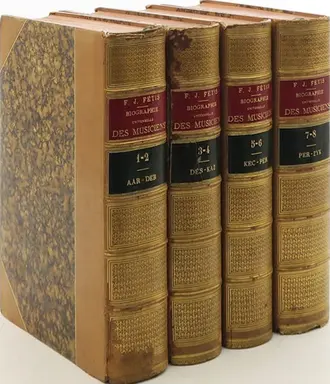
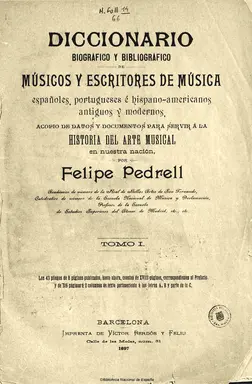
The unfinished Diccionario biográfico y bibliográfico was conceived just after the successful Diccionario técnico de la música of 1894. Like the latter, it continued earlier attempts at dictionaries of musical subjects in Spanish that trace back to the mid-19th century (most notably the 1853 Diccionario de música que contiene las voces más by Juan Cid, the 1859 Diccionario de música by Antonio Fargas and Carlos José Soler Melcior, and the 1868 Diccionario técnio: Histórico y biográfico de la música by José Parada y Barreto). With the Diccionario biográfico y bibliográfico, Pedrell sought to make a new and important contribution to Spanish music with a type of publication only previously attempted by Saldoni (1860) and by Parada y Barreto (1868), works that Pedrell held in low regard. As with the Diccionario técnico, the torso reflects musical knowledge at the turn of the century, along with an interest in musical nationalism. Over two dozen articles are substantial in scope and include the results of in-depth source studies and lengthy quotes from contemporaneous and historical sources; one such article is “Alfonso X”, which captures the accomplishments of King Alfonso X of Castile (r. 1252–84) whose commissions of music to poems authored by him, Cantigas de Santa Maria, are one of the largest medieval vernacular collections of lyric and narrative verse in praise of Mary. The entry contains substantial quotes from contemporaneous and historical sources.
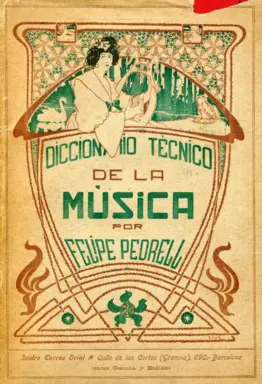
This early music dictionary, conceived between 1892 and 1894, is a treasure trove for music historiographers focusing on the Spanish perspective. Conceived by critic and music historian Felipe Pedrell, considered one of the fathers of contemporary Spanish music and musicology, it contains nearly 10,000 entries, many of which provide definitions of genres, terms, and instruments specific to the Spanish and Hispanic realm, such as romance, copla, yarabí, triste, and vihuela. Pedrell had consulted existing dictionaries as a foundation for his endeavor. At the time one of the key reference works for music researchers, the dictionary saw three further editions, attesting to the wide use and popularity of the work. Indeed, the dictionary has been highly popular due to its accessible language. Pedrell outfitted it with 117 engravings and 52 music examples. A supplement provides additional key terms. In his preface, Pedrell offered the first critical account of international music lexicography since its origins, beginning with the work of Tinctoris, and of Spanish dictionaries up to his time, noting poor quantity and quality. His deep knowledge of lexicographic techniques also surfaces in the delimitations of content and form that a specialized music dictionary should present according to him: the Diccionario técnico de la música was meant to record purely musical meanings, and offer a consistent linguistic style with clarity, accuracy, and conciseness in the definitions. Pedrell saw it as legitimate to copy the definitions of what he regarded as the “most authoritative predecessors”.