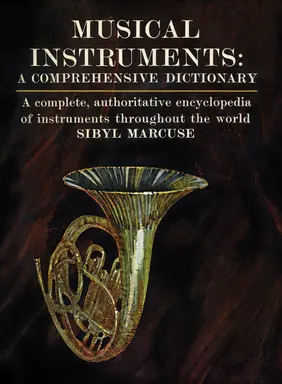
Sibyl Marcuse’s dictionary incorporates most of Sachs's material published in the Real-Lexikon, revises and expands it where necessary, and adds a vast number of new entries with copious cross-references leading the reader to additional information. Indeed, Marcuse offers thousands of entries on instruments from prehistoric times to the electronic instruments of today, and from all over the world. Entries include definitions and descriptions of instruments used in the Orient, Africa, the Americas, Polynesia, and beyond, as well as a broad treatment of instruments of the Western world. Marcuse has gone out of her way to offer information on instruments from remote places: the ha, a musical bow of the African bushman; the lumbambam, a small cylindrical drum, and the ndingi, a wooden cowbell, both of the Congo; the wurumbumba, a musical bow of the Congo and Angola; the abeng, a cane pipe of the Gabon Republic played through one nostril; the yurupuri, a wooden trumpet played in pairs by youths of the Amazon valley, and the xaque-xaque, one of a number of different Brazilian rattles; the bum-bum, a musical bow of Honduras; the ehecacozcatl, a shell trumpet of the pre-Columbian Toltec culture; the yan-ljin, the Tibetan cousin to a dulcimer; the wani-guchi, a ritual gong hung at the entrance to Japanese shrines and struck by worshippers; the zuffolo, a whistle flute of Lombardy; the zurrumbera, a bull-roarer of northern Spain; the German wurstfagott, a "sausage bassoon"; the abilosen adar, a Basque horn sounded at night to frighten away wild animals; and the eunuch flute found in Europe and resembling the kazoo (which is also called the bazoo). Marcuse’s comprehensive approach includes eclectic noisemakers, from signaling devices and bull-roarers to walkingstick violins, raft zithers, humming tops, and pibgorns. All entries are cross-referenced, etymologies are offered, and the foreign-language equivalents of the English terms are entered alphabetically in their own right. The plates of the 1964 edition show various instruments, well reproduced. In its comprehensiveness, the dictionary is indispensable for musicians, musicologists, ethnomusicologists, and curators. Anthropologists, archaeologists, sociologists, and other researchers will find much useful information as well.
With this biographical dictionary, Barnhart, a percussionist and Professor at the University of Wyoming, honors the universal language of percussion that transcends ethnic, economic, and sociopolitical boundaries. The volume offers thumbnail sketches of a huge number of percussionists born around 1950 (or earlier) who have performed primarily as soloists (e.g., Keiko Abe, Vida Chenoweth), but also orchestral performers (e.g., Fred Hinger, Vic Firth) and jazz musicians (e.g., Jo Jones, Lionel Hampton). Included are figures who made important contributions to the making and development of percussion instruments (e.g., Avedis Zildjian III). The performers covered are predominantly American and European, with some Asians and South Americans and a very few Africans. Biographies range from a few lines to a page in length and are based on both published sources and correspondence with the subjects. A selected bibliography follows each entry and includes works both by and about the subject; many entries include selected discographies and videographies.
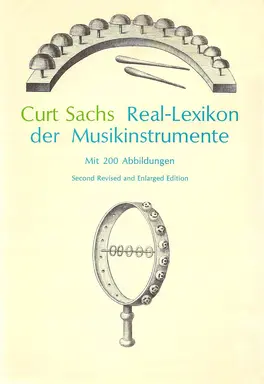
In 1913 Curt Sachs (1881–1959) saw the publication of his book Real-Lexikon der Musikinstrumente, probably the most comprehensive survey of musical instruments in 200 years, conceived by the German pioneer of instrument research. The value of Sachs's Real-Lexikon hardly needs mentioning: it covers instruments from all peoples and nations from Greek auloi to Chinese temple instruments to Peruvian silvadores; it emphasizes philological aspects of the names of instruments, rendering their names in Arabic, Cyrillic, Greek, Hebrew, and Sanskrit. Over the course of many decades, Sachs annotated his personal copy with corrections and additions. Based on this work, his wife Irene Sachs issued a second edition five years after his passing. It contains 600 emendations incorporated into the body of the book and 500 new entries dedicated to folk and non-European instruments that are grouped together alphabetically in a supplement at the end, along with the requisite supplementary bibliography. The revised and enlarged version preserves the 200 line drawings of the first edition.
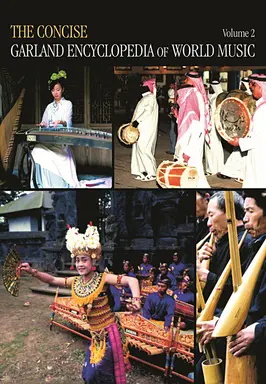
The concise Garland encyclopedia of world music remains true to the global inclusiveness and scholarly integrity of the original ten-volume edition, while reducing the page count by 95 percent. Some essays were shortened or updated, in-text references were removed, and scholarly terms were replaced with more familiar ones (such as “wind instrument” instead of “aerophone”). The arrangement is geographic, with a decided emphasis on Asian musical traditions, which take up all of the second volume. The essays focus more on instrumentation, contexts, and genres than on artists or recordings. Ideal for a nonspecialist readership, The concise Garland is also valuable for a specialist readership because of its up-to-date and complementary content.
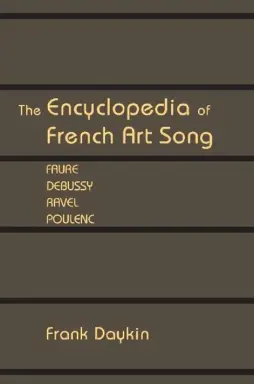
A comprehensive reference work dedicated to the French mélodie, with a particular focus on the art songs of Gabriel Fauré, Claude Debussy, Maurice Ravel, and Francis Poulenc. The volume features entries on individual songs, accompanied by discussions of relevant poems, poets, historical and cultural contexts, and specialized terminology. Designed to support singers, pianists, educators, and scholars, the encyclopedia offers interpretive commentary on performance practice, programming considerations, and the intricate interplay between music and text. Extensive cross-referencing facilitates the exploration of thematic and contextual connections across the repertoire. Reflecting the author’s expertise as a pianist, teacher, and musicologist, the work serves as both a pedagogical tool and a resource for research and performance preparation. It makes a significant contribution to the study and appreciation of French art song.
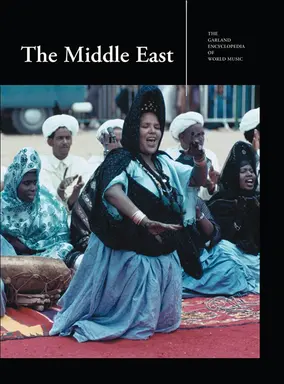
Garland Publishing first issued The Garland encyclopedia of world music between 1988 and 1994 as a ten-volume series of encyclopedias of world music. An updated second edition appeared between 1998 and 2002. It is widely regarded as an authoritative academic source for ethnomusicology. The volumes included in the RILM Music Encyclopedias are Africa (ed. Ruth M. Stone), The United States and Canada (ed. Ellen Koskoff), Southeast Asia (ed. Terry E. Miller and Sean Williams), South Asia: The Indian Subcontinent (ed. Alison Arnold), The Middle East (ed. Virginia Danielson), East Asia: China, Japan, and Korea (ed. Robert Provine), and Australia and the Pacific Islands (ed. Adrienne L. Kaeppler). Each volume consists of three sections that “cover the major topics of a region from broad general issues to specific music practices” (Preface): An introduction to the region, its culture, and its music as well as a survey of previous music scholarship and research; major issues and processes that link the musics of the region; and detailed accounts of individual music cultures. The entries synthesizes exhaustive fieldwork conducted since the 1960s, as well as recording, analysis, and documentation. This publication is a landmark achievement in ethnomusicology. While ethnomusicologists can appreciate The Garland for its critically designed components, non-ethnomusicologists can embrace the encyclopedia for its capacity to serve as a primer on world music.
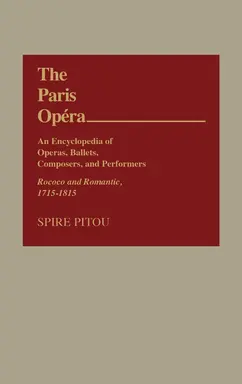
The Paris Opéra: An encyclopedia of operas, ballets, composers, and performers
Spire Pitou, who served as Professor of French Language and Literature at the University of Delaware, produced in this book an exhaustively detailed encyclopedia of every opera and ballet produced at the Paris Opéra, or the later Opéra-Comique, from 1671 to the 1980s. It is of special value to those who requiring in-depth information on opera in France. Entries for operas and ballets include composer, librettist, choreographer, costumer, set designer, important performers, and a scene-by-scene/act-by-act analysis. Separate entries are also devoted to performers, composers, choreographers, librettists, genres, and scenographers. Each of the three volumes begins with a concise historical overview for its assigned time period, which is informative and helpful for anyone requiring orientation on French operatic tradition.
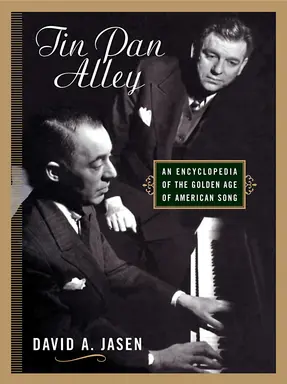
Tin Pan Alley: An encyclopedia of the golden age of American song
In Tin Pan Alley, David Jasen, a Professor of Communications at C.W. Post College (Long Island University) and an authority on ragtime, tells the story of American popular song, as it was composed, published, and marketed from its heyday in the 1880s to Tin Pan Alley’s demise in the 1950s. It does this through over 400 individual entries, each featuring a composer, lyricist, performer, publisher, style, or song title. One entry of particular interest is headed Hit Songs. Twenty pages cover the years from the 1890s to 1955; for each year, four or five successes are described with recording details and annotated entries for the era's blockbusters. Since Tin Pan Alley was essentially a publishing movement, Jasen includes publisher entries, often with dates and addresses. Tin Pan Alley is a unique compendium on American popular song and the business of selling music.