Biographical dictionary of Afro-American and African musicians
With the Biographical Dictionary of Afro-American and African musicians, Eileen Southern (1920–2002), who served on the faculty of Harvard University and before 1971 was known primarily as a Renaissance scholar, created a long-needed resource and a major research tool. It is the first single comprehensive volume of its kind that "attempts to correlate materials" concerning Afro-American and African professional musicians "from a historical perspective" (Preface). It contains information on well over 1,500 figures, the earliest being Sebastian Rodriguez, born ca. 1642, an African drummer who was active in Mexico and died in El Paso; the birth cutoff date is 1945 (with some obligatory exceptions, such as Kathleen Battle and Wynton Marsalis). Coverage is not limited to the United States and Africa. Sixty-five musicians from Canada, South America, and Europe are included as well. This is not another dictionary confined to jazz musicians, gospel performers, or those engaged in minstrelsy; it is a survey of the lives of black men and women who have contributed to any aspect of musical history, and as such an enormously useful reference book.
Broadway: Its history, people, and places—An encyclopedia
Theater historian Ken Bloom’s 1991 first edition of Broadway offered a fact-filled compendium of Broadway's theaters, personalities, awards, publications, and notable concepts (e.g., “stunts”), from the earliest days to the present. This new edition adds corrections and updates, and multiple cross references for easy browsing. The most substantial entries cover theaters, playwrights, composers, directors, performers, and producers; there is a special emphasis on composers and lyricists, because Bloom believes that “they had greater impact on American theatrical history” (Preface). This is not a show-by-show account (only a small number of major shows have solo entries), but a history of the Great White Way.
Paese: Stati Uniti
Lingua: inglese
Argomento: musica popolare, interpreti, opera e teatro musicale
Československý hudební slovník osob a institucí (The Czechoslovak music dictionary of people and institutions) took almost two decades of broad collaboration between leading Czech and Slovak music specialists involved in the academy and general musical life. The dictionary offers 9500 entries in either Czech or Slovak depending on the subject. Articles are devoted to Czech and Slovak personalities active in all kinds of areas of musical life; to institutions, organizations, and performing groups; to editions and publications such as music journals; as well as to individuals and organizations of amateur and folk music production. The dictionary was conceived as a postwar response to the then first modern Czechoslovak music dictionary, Pazdírkův hudební slovník naučný (1933–37 and 1938–40), which was censored by the Nazis and interrupted by World War II. Československý hudební slovník osob a institucí correlated with the establishment of the first musicology institutes in Prague and Bratislava. Thus it reflects the beginnings of scholarly activities in postwar Czechoslovakia. The Czech portions have served as the basis for the 2008 online project Český hudební slovník osob a institucí, published by the Centrum Hudební Lexikografie at the Masarykova Univerzita in Brno.
Conductors and composers of popular orchestral music: A biographical and discographical sourcebook
Reuben Musiker, formerly a Professor of Librarianship and University Librarian at the University of the Witwatersrand, and his wife, Naomi Musiker, who is also a trained librarian, provide biographical information and a discography for around 500 individuals who have written popular and mood music for film, show, and the theater. First published in 1998, this sourcebook delves deeply into the recent history of popular orchestral music, covering the latter half of the 20th century. The main focus is on the peak period for such music, the 1940s through the 1960s. The key players are from the U.S. and Great Britain, or became popular there. They include classically trained conductors (Morton Gould, Andre Kostelanetz), swing-era conductors and arrangers, composers for film and theater (Alfred Newman, John Williams), mood or background music composers, and relevant institutions (101 Strings, Reader's Digest). Those who composed for military and brass bands, dance bands, or jazz ensembles are, for the most part, excluded. While some of the more well-known names here can be found in other sources, this title is a useful addition to larger music collections due to its unique and narrow focus.
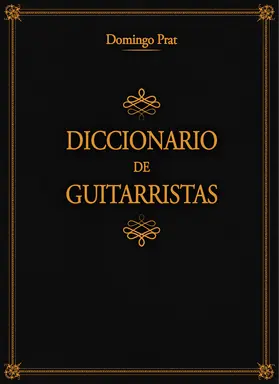
Diccionario biográfico – bibliográfico – histórico – crítico de guitarras y guitarristas
A noted teacher of the guitar, Domingo Prat (1886–1944) published the Diccionario de guitarristas in July 1934 in a limited edition of 1605 copies, all of which he personally signed. He built on a number of earlier lexicons and histories of the guitar, such as Philip J. Bone’s The guitar and mandolin of 1914, and Josef Zuth’s Handbuch der Gitarre und Laute, Maria Rita Brondi's Il liuto e la chitarra, and Fritz Buek’s Die Gitarre und ihre Meister, all three published in 1926, as well as Ricardo Muñoz’s Historia de la guitarra of 1930. Acutely aware of these publications, Prat did not deem them entirely successful in their respective missions and aimed at ameliorating the work of his predecessors by providing a systematic account of his sources. Many entries contain quotations from such valuable source materials as newspapers and treatises. The Diccionario de guitarristas covers a wealth of information on the guitar and related subjects—the recognized masters of the past and present, Prat’s colleagues in Buenos Aires and abroad, obscure amateurs, celebrities, students in whom he saw a promise, mythological figures, and even fictional personalities from general literature—from the earliest times, through the Renaissance, Baroque, and the Classic era up to and including the early 20th century. It covers four main areas of interest: South American guitar music in general and Argentine guitar music in particular; the guitar in Spain; contemporary guitar; and guitar history. Numerous references pertain to individuals from the world of flamenco, or género andaluz as Prat called it. The Diccionario offers separate sections on luthiers, instruments, dance, and terminology. The exhaustive appendix exclusively focuses on guitar makers.
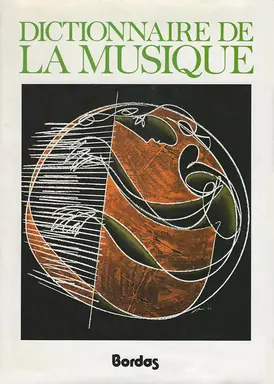
Dictionnaire de la musique: Les hommes et leurs oeuvres
With the collaboration of more than 200 European, and American musicologists, in 1970 the French musicologist Marc Honegger (1926–2003) assembled the first edition of his comprehensive biographical encyclopedia. This new edition includes 5,500 entries over two volumes. The entries cover a diverse range of musical personalities, from composers and performers to musicologists, music theorists, instrument makers, and music editors. The composer entries include a list of works; most entries feature a bibliography. French musical life is a particular strength of this encyclopedia, which contains entries on French figures who are not included in Grove or MGG. Some 20th-century figures, such as the composer Olivier Messiaen, wrote autobiographical entries for the Dictionnaire de la musique, an uncommon feature that reveal how these composers wished to be remembered. In addition to these unique perspectives, the entries on standard subjects such as Beethoven, Mozart, or Schumann contain original insights that one might not expect to find in an encyclopedia of this length. This makes the Dictionnaire an essential reference tool for any researcher of French musical culture.
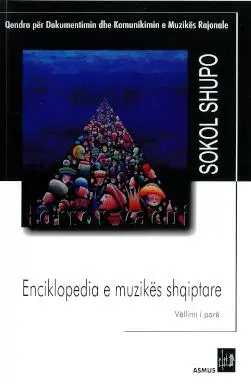
With the Enciklopedia e muzikës shqiptare, Sokol Shupo, an Albanian music researcher and composer who serves on the faculty at the Academy of Arts in Tirana, pays tribute to the many important figures in Albanian music history who are not recognized in other encyclopedias. The encyclopedia offers 186 entries on performers, composers, musicologists, and others active in Albania’s music scenes, from Petrika Afezzoli, conductor and a faculty member at the Academy of Arts in Tirana, to the composer Nikolla Zoraqi, who had made an important contribution to the development of new Albanian music. Many of the musicians who received an entry are still active in Albania today. Those who have moved abroad are only included to a limited extent. Given the condition of archives and collections in Albania and the absence of a national music bibliography, this encyclopedia provides the most complete and verified information on the history of Albanian music. It is the first single comprehensive volume of its kind.
Paese: Albania
Lingua: albanese
Argomento: interpreti, compositori, musica tradizionale
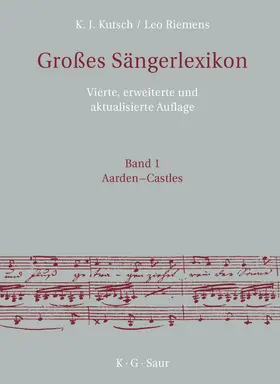
The Großes Sängerlexikon (usually briefly cited as Kutsch/Riemens, after its founding editors) is considered the world’s most comprehensive dictionary of singers—the famous, the less well-known, and the almost forgotten—from all over the world, active in opera, operetta, oratorio, religious and art song, and other mostly Western classical forms of vocal music. Karl Josef Kutsch (b.1924), a collector of records and singer biographies, and the Dutch musicologist Leo Riemens (1910‒85) started this endeavor in the 1950s. After Riemens’s death, the high school teacher Hansjörg Rost (b.1942) played a major role, becoming an official coeditor in 1994. The fourth edition is updated and vastly expanded, especially when compared with the 429-page first edition (1962). It spans seven volumes that contain nearly 20,000 biographies of singers from the 16th century to the present. The detail is unique: Each biographical article contains stage name, common name, register of voice, and biographical dates. This information is followed by details on the artist’s background and musical career organized by places of work, major works, a short list of biographically significant engagements and appearances, a voice characterization and, in the case of major artists, bibliographical details and references to recordings. The Großes Sängerlexikon is remarkable not only for the vast scope of its material but also for the extensive period of time and variety of genres that have dominated the art of singing since the late 16th century—opera, oratorio, aria, cantata, lied, religious vocal music—whilst remaining as up-to-date as possible. It is the standard reference work for any lover of singing.
Historical dictionary of the music and musicians of Finland
The brainchild of the third-generation Finnish-American musicologist and music educator Ruth-Esther Hillilä and the musicologist Barbara Blanchard Hong, the Historical dictionary is the only comprehensive English-language reference source devoted to Finnish music culture. It is designed to “unlock Finnish music for scholars and others” (Preface). It provides information on Finnish music history from 50 B.C.E. to the late 20th century. It covers art music, including operatic and orchestral performers, musicologists, and music educators, but excludes popular music. The majority of the entries are biographical about individuals, but there are also entries for musical organizations such as choirs, festivals and competitions, and some entries for general music terms such as cantor. The encyclopedia also includes a pronunciation guide and a map of Finland that pinpoints locations of major music festivals. The authors draw their information from a variety of sources and document them at length. The breadth and quantity of the entries cannot be matched by more general sources. There is very little overlap with other encyclopedias, with the exception of a few composer entries and the Finnish musical elements discussed in Grove’s Finland article.
Hollywood songsters: Singers who act and actors who sing—A biographical dictionary
This dictionary on the careers of singers who appeared in Hollywood motion pictures provides specialized information while also creating a broader overview of the subject area. The authors, who have worked in the entertainment field, have given 104 singers individual attention (among them familiar names such as Frank Sinatra, Sophie Tucker, and Mae West) with information on their recording activities and appearances in film. The volumes cover the first nine decades of the 20th century.