Biographisch-Bibliographisches Quellen-Lexikon der Musiker und Musikgelehrten
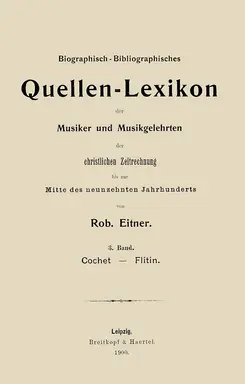
Robert Eitner, an autodidact in matters of music, began his musicological activities in 1868 with the foundation of the Gesellschaft für Musikforschung, which is still in existence today. He initiated several publication series before devoting himself to the seminal Quellen-Lexikon—a pioneering work in its size and ambition. At the time when Eitner conducted his work in libraries throughout Europe, many of them did not have a separate music catalogue. Eitner’s achievement was truly remarkable, especially in that he recognized the necessity of establishing an inclusive indication of sources. He was a pioneer in music source documentation, coining the famous phrase that “music bibliography is the foundation of all historical knowledge” (Preface). Eitner’s work retains its validity even today, even though the premises for source documentation have fundamentally changed through revolutionary technological developments. Numerous collections cited by Eitner were lost or destroyed during the wars, and thus his references remain the only ones (many not even included in RISM). The work is much more than a listing of manuscripts and prints. With its perspective on the sources in their local and supraregional context, it provides insights about known and unknown compositions, personalities, and music institutions. In turn, it is itself a piece of music history. A lexicon of sources, the “Eitner”, as it has become known, is a classic in musical source study and an essential reference for musicologists.
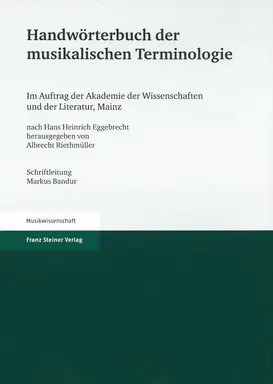
Handwörterbuch der musikalischen Terminologie 是一部专门研究音乐术语的形成、历史与含义的辞书。经过大量前期准备,该书于1971年至2006年间以活页形式分期出版,最初由 Hans Heinrich Eggebrecht(1919–99)主编,在其去世后由音乐学家 Albrecht Riethmüller 接任。随着2005年秋季第40期活页的发行,该项目宣告终止。Handwörterbuch 共收录247个术语,篇幅逾3700页(最初分装于六个文件夹中)。撰稿人严谨的辞书编纂功力令人称道;较复杂条目开头的提要尤为实用。
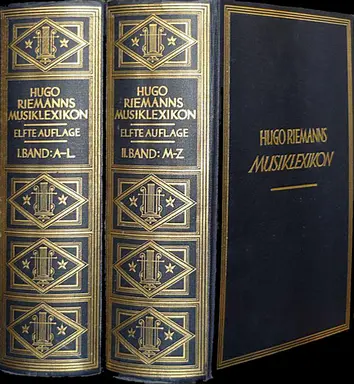
Riemanns Musik-Lexikon is one of the last comprehensive music encyclopedic endeavors undertaken by a single person: German musicologist and theorist Hugo Riemann (1849–1919). He published the first edition in 1882. Subsequent editions constantly expanded scope and, until the eighth edition of 1916, were largely edited and published by Riemann himself. His last edition, the ninth of 1919, appeared after his death. Musicologist Alfred Einstein completed it, and also enlarged and revised the subsequent editions, until his forced emigration from Nazi Germany. Because of Einstein’s later work in the English-speaking world, the lexicon became known and respected in Anglo-American musicology. The eleventh edition is of note because it is the first to appear in two volumes, showing the lexicon’s ever expanding scope. Yet at the same time, Einstein eliminated a great number of biographical entries from the previous edition, for names he deemed more important; this edition thus represents both expansion and selection in accordance with the zeitgeist of the late 1920s. It is an excellent source of information for research on musical life in Germany (and to some extent also other European countries) in the 1920s.
Neues historisch-biographisches Lexikon der Tonkünstler
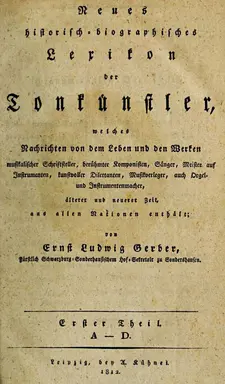
After Ernst Ludwig Gerber (1746–1819) completed the two-volume Historisch-biographisches Lexikon der Tonkünstler (1790–92), J.F. Reichardt and E.F.F. Chladni, among others, contributed substantial additions. Combined with new materials that Gerber himself assembled (in particular the work of Martini, Burney, Forkel, Reichardt, and Chladny), these formed the basis for the four-volume Neues historisch-biographisches Lexikon der Tonkünstler. The content of Neues historisch-biographisches Lexikon der Tonkünstler was rethought in light of the new material. Some entries are entirely rewritten, others contain additions; many of the entries found in the Historisch-biographisches Lexikon der Tonkünstler are omitted. Gerber did not aim at a critical approach: He created a historical and biographical dictionary of musicians that contains news of the life and works of music scholars, famous composers, singers, accomplished amateurs, music publishers, manufacturers of organs, and instruments of ancient and modern times and of all nations. In spite of some flaws, the lexicon has been considered since its publication a unique and valuable source, especially for late-eighteenth-century music, because of the quantity of material drawn from Gerber’s personal contacts with the great musicians of his time. Portions of it can be found in translation in music dictionaries by Choron-Fayolle, Sainsbury, and Lichtenthal. It continued to hold the interest of the scholarly world; Gerber himself compiled further additions, and Carl Mainberger (1816) and F.S. Kandler (1817–20), among others, provided supplementary material. A new edition announced in 1825, however, did not come to fruition.