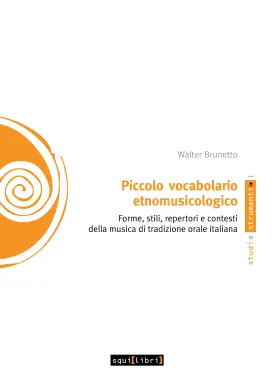
A landmark reference work for the study of Italian traditional music, this volume offers a coherent, structured, and systematic lexicon devoted entirely to orally transmitted musical traditions. Presenting more than 500 entries, each accompanied by analytical notes, cross-references, and concise bibliographic indications, the Piccolo vocabolario etnomusicologico serves as a pioneering tool designed to support both the cataloguing and indexing of sound documents held in archives and documentation centers and the needs of academic research. Its extensive terminological apparatus—covering oral and written forms, genres and repertories, performance styles, functions, occasions, and cultural contexts—illuminates the richness, diversity, and vitality of Italy’s musical traditions across regions and communities. The work provides an integrated conceptual framework that foregrounds the relationships, continuities, and distinctions among practices, repertoires, and contexts. It stands as an essential guide for students, musicologists, ethnomusicologists, archivists, and cataloguers seeking to navigate the complex and multifaceted universe of Italian traditional musics.
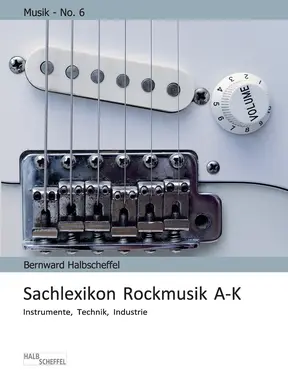
The Sachlexikon Rockmusik contains 1323 articles on the terminology and topics of rock music and its performance—musical instruments ranging from electric guitar to the theremin; the equipment necessary for concerts and studios, including microphones, amplifiers, and mixing boards; small record companies and market-dominating media corporations; esoteric terms such as “Skunk Stripe”, “Geri Reig”, “Mucke”, “Fliegen”, and “Toasting”; genres ranging from AOR to Acid; and terms used in music theory as they pertain to rock. Discographies, bibliographies, and web references complete the articles. The boundaries of rock music are often crossed into pop and jazz. Cross-references provide an extended overview of a topic and help to better understand its context. A bibliography and an index of commercial names and references round off the encyclopedia.
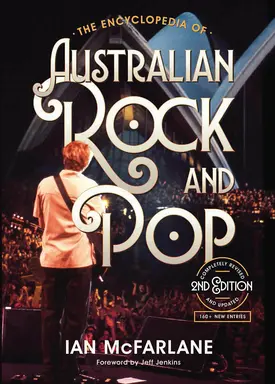
The encyclopedia of Australian rock and pop embeds a brief history of pop and rock musical developments Down Under with a wealth of information on personalities, bands, and institutions. This second edition has been completely revised and updated, adding over 160 new articles to the previous 870 entries. With articles on AC/DC, The Avalanches, Olivia Newton-John, and Guy Sebastian, as well as You Am I and Zoot, it is the most comprehensive guide to artists who molded Australian popular music from 1956 to 2016. Each article contains biographical information, line-up details, record releases, career highlights, and album discographies, as well as an authoritative critique on each artist’s career. Major entries have references for further reading. This comprehensive approach makes transparent the impact of singers and bands such as Johnny O'Keefe, Marcie Jones, and The Delltones; Sherbet and Daddy Cool, and Human Nature; and personalities such as Darryl Cotton, Johnny Young, Tina Arena, and Kylie Minogue. There is extensive coverage of those who have had long-standing local careers, such as John Farnham, Jimmy Barnes, and Col Joye; those who have enjoyed significant international careers, such as Rick Springfield, Helen Reddy, and The Bee Gees; as well as recognition of lesser-known live bands, such as the eccentrically named The Band Who Shot Liberty Valance, and bands who may not have recorded but still made a contribution to Australian popular music history. The attention to detail reveals itself in facts such as former Australian Prime Minister Paul Keating managing a 1960s rock band. This is an essential work of reference for anyone seeking information on Australian popular music and its impact abroad. A bibliography is included at the end of the encyclopedia.
A comprehensive reference work dedicated to the French mélodie, with a particular focus on the art songs of Gabriel Fauré, Claude Debussy, Maurice Ravel, and Francis Poulenc. The volume features entries on individual songs, accompanied by discussions of relevant poems, poets, historical and cultural contexts, and specialized terminology. Designed to support singers, pianists, educators, and scholars, the encyclopedia offers interpretive commentary on performance practice, programming considerations, and the intricate interplay between music and text. Extensive cross-referencing facilitates the exploration of thematic and contextual connections across the repertoire. Reflecting the author’s expertise as a pianist, teacher, and musicologist, the work serves as both a pedagogical tool and a resource for research and performance preparation. It makes a significant contribution to the study and appreciation of French art song.
